If you are an author, prepare to shine in our engaging and exclusive writer’s interview! Your book will be the focal point as Nora dives deep into its intricacies, unearthing the themes, characters, and insights that make you and your work unique. In this personalized question-and-answer format, Nora will craft thought-provoking questions that highlight the essence of your novel or nonfiction masterpiece, showcasing your literary journey and the passion behind your writing. Get ready to illuminate your story like never before! This written author interview is a literary conversation that goes behind the words… Nora D’Ecclesis

Click here to listen to the episode:
https://directory.libsyn.com/episode/index/id/33048827/tdest_id/414585
Charlie’s Show Notes:
Hi Paul. My guest today, author and Zen Master, Nora D’Ecclesis joins us to discuss her latest fiction, The Contessa’s Legacy. Beginning in Pompeii, 79 AD, Nora guides us through 2000 years of a history of resilience, perseverance, and commitment—all for the sake of what she calls, “Generational Legacy.”
The story moved me, but not as much as the ideology—so much for those of us that live in our heads and hearts. What is required for a passionate mother to leave with her family the very best of family tradition as they are forced to deal with the distractions of life?
Nora tells us the how one family made it and how it just might be a model for all of us to follow or institute in our families today.
At this point in the introduction I would normally offer up an overview of Nora’s accomplishments. But as is typical with those in humble spiritual practices, Nora is quite private. It’s almost impossible to even find what we might consider a bio or resume. So… let’s just let Nora’s work and conversation speak for itself.
LINKS
Find out more about Nora D’Ecclesis at her website: https://noradecclesis.com
Please check out Nora’s latest novella, The Contessa’s Legacy. The book is already an award winner!
On a cool clear night looking up at the sky, from a lounge chair on the deck, the constellations are dramatically brighter than normal. A feeling of total tranquility emerges with relaxation often found in nature’s beauty. The Big Dipper and its seven bright stars look painted in the sky. It is said that the ancient Greeks named the Big Dipper “Bear.” They saw the same sky I am joyfully visualizing in a different century. The Greeks have tales from their Gods Zeus and Hera about a squabble over the way Zeus was always philandering with other women, so his wife Hera propelled her into the sky where she remains to this day in the Heavens. Who can refute Hera’s power if one reflects that Ursa Major never sets below the horizon in mid-northern latitudes. Now the Native Americans knew bears did not have long tales like the Big Dipper, so they taught that tail latitudes were three hunters chasing the bear.
During the American Civil War history projects a vision of slaves escaping from the sub-human treatment as they followed the North Star to freedom. They told each other of the drinking gourd helping the underground railroad to find their way north. As history begins to subside in the thoughts a more meditative journey begins… We look for our personal North Star for guidance when we experience the disquietude of chaos in our lives. Our path points in the direction of our Polaris and the spiritual and emotional elements bringing us toward better quality of life. In our youth it was easy. We simply looked up to our parents and teachers who always gave us good direction and set us on a course. As adults it is more complex formulating our life purpose and searching for a constant to draw strength. Ultimately our strength comes from within. We are strong. We are capable of leadership.
We are capable of accomplishing everything we want out of life. Do not doubt yourself. Your North Star is now your personalized path. Struggle will always precede great accomplishment. Through it all continue to move forward. Your place on earth is one of great importance. Whether we realize it or not we have all touched other people’s lives. Taking good care of our mind, body and spirit will allow us to live our lives with abundance and continue to touch others with love and radiate humble appreciation for all the gifts in life. Many of us desire change in our lives but are unsure how to proceed. Begin by affirming concepts that are essential, yet often forgotten or ignored. Relax and refocus. Appreciate what we have instead of dwelling on what we don’t. Remember that change is inevitable. Break with old patterns that hold us back from our potential. Prevent negative thoughts and people from controlling our lives. Remain calm through adversity.
The guiding star directs us toward a more spiritual life filled with compassion, equanimity and love. Envision yourself as you would like to be, and do not give up that as your mission in life.
Nora D’Ecclesis — published in Multicultural Mindfulness

I was recently a guest on the Every Day Peace podcast with Dr. Dravon James:
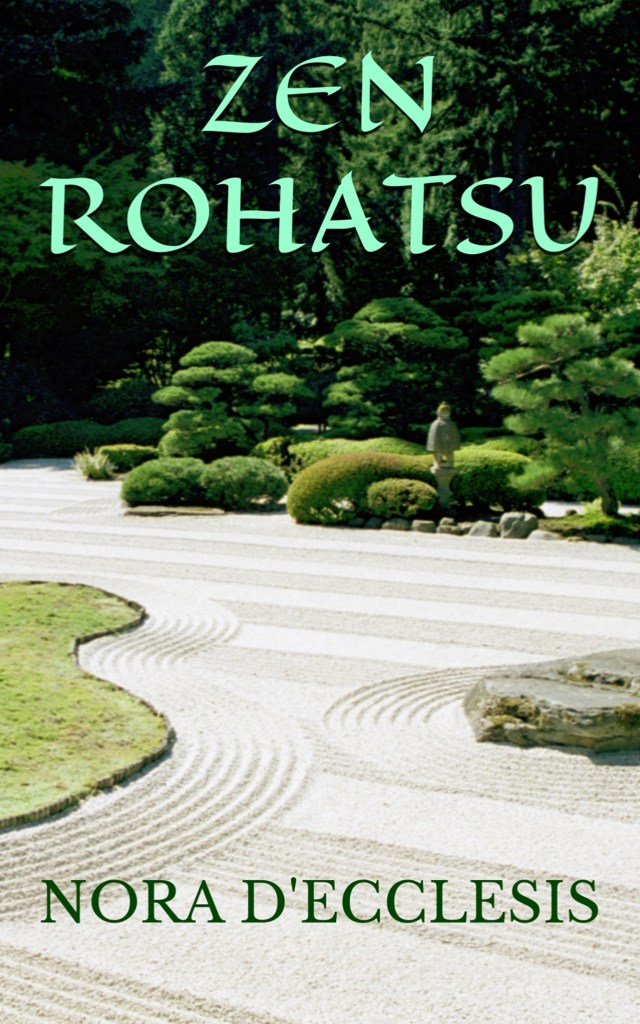
Barbara Bamberger Scott reviews Zen Rohatsu…

Noted non-fiction author Nora D’Ecclesis addresses the mystical yet pragmatic practices of Zen Buddhism from a wide array of historical perspectives in her newest book, Zen Rohatsu.
The author’s opening chapter describes her personal experience of Rohatsu, a ritual of meditative zazen named for the timing of the ceremony which in modern times has evolved to fall on December 8th each year. “Rohatsu begins with the sound of an ancient gong” and is meant to duplicate the steps of the enlightenment of the Buddha. It includes classic seated meditation and much walking in circular paths indoors and out, all accomplished in total silence, giving each participant scope to experience mindfulness.
Zen is one aspect of Buddhism that has gradually developed over the centuries since the birth, life and passing of Siddhartha Gautama Buddha. Siddhartha was the son of a Nepalese, Hindu king, heir to all the luxuries that station implies. But after he achieved manhood, he began to wish to see what lay beyond the walls of his father’s castle. Once he did so he saw things he had never before confronted – sickness, old age, and death. This led him on a path of asceticism and eventually to being revered as a spiritual teacher of the Eightfold Path, which D’Ecclesis presents along with other concepts for her readers. The art of Zen developed through the fabled teachings of Boddidharma, the 28th Patriarch of Buddhism, and through the conversion of Ashoka, a famed King of India. Jesuits and other mystic thinkers brought Zen to the Western world, along with the arts of the Japanese tea ceremony, the poetry known as haiku, and the modern concept of mindfulness.
D’Ecclesis concludes her enlivening look at Zen with detailed advice for meditation encompassing postures, breathing techniques and mala beads, offered for readers who want to inculcate this ritual into their lives as she has done. She was fortunate to have direct exposure to Zen in her college years, and has written best-selling, award-winning books embracing similar subject matter, including Multicultural Mindfulness: Nourishing the Soul and Haiku: Natures Meditation. This current work is diligently researched, combining historical reference with tender, personal touches to provide outreach to those new to the subject matter.
Quill says: In Zen Rohatsu, D’Ecclesis has created a straightforward guide to the concepts of Zen with the potential to attract fresh attention to this time-honored, proven means of mental and spiritual self-examination.
This review originally appeared here: https://featheredquill.com/zen-rohatsu/
Michael Froilan reviews Zen Rohatsu…
Buddhism is one of the world’s most intriguing religions and has carried a compelling aura around it for years. Although technically not a religion, it has influenced millions of people to practice its sacred philosophies with devotion. Zen Rohatsu is a far-ranging book that primarily summarizes the Buddhist holiday globally celebrated on the Gregorian calendar’s eighth day of the twelfth month, which is believed to be the day Guatama Buddha achieved enlightenment while meditating under a banyan fig tree. Written by author Nora D’Ecclesis, this compact book contains a substantial amount of unique teachings, history, and traditions regarding Buddhism, not to mention a vast background on Zen which “is just one branch of the Buddhist tree.”
I treasure this masterpiece. The well-thought words and information Nora D’Ecclesis writes encouraged introspection and inspired me to take my spiritual practices more seriously. It’s interesting to ponder just how much Buddhism has positively impacted many people’s lives on a universal scale. D’Ecclesis does a remarkable job accentuating this truth. For instance, she mentions King Ashoka, who renounced warfare and devoutly committed himself to spread Buddhism worldwide. I also enjoyed learning more about other historic spiritual giants, especially the stories of Siddhartha Gautama’s life, which D’Ecclesis tells poetically. Most people tend to overlook that it took Buddha six years to reach enlightenment, and there were many enlightened ones before him. Living in a fast-paced world, we want our desires to quickly manifest so that we tend to forget to cherish and be mindful of every fleeting moment. Zen Rohatsu was refreshing to read because it made me realize that nothing worthwhile comes from forcing anything. Praiseworthy, formidable, and exceptional, this is a monumental book from which I sincerely believe all strata of society can benefit.
The fascinating words in the news these days, where did they come from? We see fraternities and hurricanes named after the Greek Alphabet but they are also used by scientists. The many words used by modern medicine are from the Greek Alphabet as the go-to choice enabling a more neutral connotation on naming viruses.
The Greek Alphabet began in the Ninth Century, but originated from the Phoenician Alphabet. The Greeks added consonant’s to the vowels in their letters. The naming system, now used by W.H.O., makes public communication about virus variants easier and less confusing. They will use the Greek Alphabet.
Dr. Angela Rasmussen, a virologist at the University of Saskatchewan, said she conducted many interviews with reporters this year, before the Greek naming system was announced, and she stumbled through confusing explanations about the variants. They are now known as Alpha, which emerged in the United Kingdom, and Beta, which emerged in South Africa. “It makes it really cumbersome to talk about when you’re constantly using an alphabet soup of variant designations,” she said, adding, “Ultimately people end up calling it the U.K. variant or the South African variant.”
That’s the other big reason that the W.H.O. moved to the Greek naming system, Dr. Rasmussen said: “The older naming convention was unfair to the people where the virus emerged. The agency called the practice of describing variants by the places they were detected “stigmatizing and discriminatory.”
“The practice of naming viruses for regions has also historically been misleading,” Dr. Rasmussen said. Ebola, for example, is named for a river that’s actually far from where the virus emerged. “From the very beginning of the pandemic, I remember people saying: ‘We called it the Spanish flu,’ Dr. Rasmussen said. “The Spanish flu did not come from Spain.”
The W.H.O. encouraged national authorities and media outlets to adopt the new labels. They do not replace the technical names, which convey important information to scientists and will continue to be used in research.
Source
The New York Times, 27 November 2021.
| Α | α | alpha |
| Β | β | beta |
| Γ | γ | gamma |
| Δ | δ | delta |
| Ε | ε | epsilon |
| Ζ | ζ | zêta |
| Η | η | êta |
| Θ | θ | thêta |
| Ι | ι | iota |
| Κ | κ | kappa |
| Λ | λ | lambda |
| Μ | μ | mu |
| Ν | ν | nu |
| Ξ | ξ | xi |
| Ο | ο | omicron |
| Π | π | pi |
| Ρ | ρ | rho |
| Σ | σ, ς | sigma |
| Τ | τ | tau |
| Υ | υ | upsilon |
| Φ | φ | phi |
| Χ | χ | chi |
| Ψ | ψ | psi |
| Ω | ω | omega |
I was recently a guest on the Wisdom of Ages podcast with Ayn Cates Sullivan:
What are the different ways of spirit? How can we evolve and become free? In this episode of Wisdom of Ages, host Ayn Cates Sullivan and guest Nora D’Ecclesis discuss the different traditions of cultures when it comes to spiritual approach. Furthermore, they tackle the Shinto tradition of Japanese, Haiku poetry, and the Japanese Tea Ceremony. Tune in and join Ayn and Nora as they talk more about global mysticism and multi-cultural mindfulness.
You must be logged in to post a comment.